For small hospitals and physician practices, marketing dollars often have to stretch a long way. Fortunately, some of the most effective strategies, like blogging, Google Business Profiles, and targeted digital ads, are also among the most affordable.

While Search Engine Optimization (SEO) and Generative Engine Optimization (GEO) can feel like scary things to tackle, at the end of the day, they are all about showing off your organization’s expertise and highlighting the care you have for your community. Sure, SEO/GEO can get pretty technical, but the real game-changer is having content on your website that actually speaks to your target audience.
All it takes is recognizing what makes your hospital or clinic special and making sure your online presence reflects that.
Blogging is one of the best ways to improve visibility and build trust. Posts that answer patient questions or share seasonal health tips demonstrate expertise and help your site rank higher in search results. Warner Hospital’s blog called “Staying Safe This Summer” is a good example—posted in the summer, this post addressed timely concerns in Warner’s community, boosted local SEO, and reinforced the hospital’s authority.
People often ask, “But what should we be blogging about?”
Keeping an 80/20 balance of educational to promotional content is a good place to start. Your blog should be a place where you educate patients with accurate and helpful health information, but it should also point them to where they can get the help they need. Make sure to also make posts that promote the events that you have going on or that celebrate the accolades you receive. Prospective patients want reassurance that they can trust their local hospital or healthcare facility.
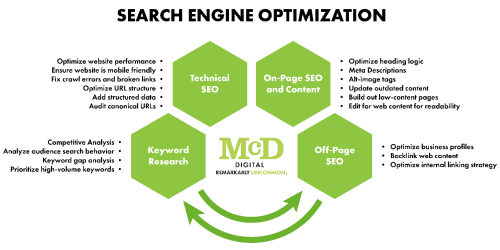
Google rewards content written for humans. This may sound obvious, but with the rise of AI tools being used in normal workflows, it is important to emphasize. Make sure that the content on your website is written by humans for humans. That means plain language, provider-reviewed posts, and storytelling that patients can connect with.
Breaking content into clear, well-labeled “chunks” helps AI tools like Google’s AI Overviews and ChatGPT easily identify and pull relevant answers. Chunking content into short, focused sections, each addressing a specific question or topic, makes your pages more discoverable and more likely to be featured in AI-generated responses.
Of course, AI tools can be very helpful in content creation, especially if you have a small marketing team that is already spread pretty thin. Please feel free to use these tools to help with content but always make sure that content is reviewed by real people if it is going to be put up on your website.
A free Google Business Profile (GBP) often serves as your first impression. Look at it as your organization’s social media profile – only instead of being on a traditional social platform, it shows up in the organic search engine results. Your GBP also ensures that your organization is listed on Google Maps, making it easier for people to use their GPS to find you.
All it takes to optimize your profile is to make sure the information is accurate. Simply log into your Google account, search your organization, and your profile will show up to the right. Edit the information to have the correct website URL, address, hours of operation, photos of the specific location and contact information. While there are many other things you can add, making sure your basic information is correct will go a long way in strengthening your online presence.
Treating your GBP as an extension of your website is an easy, no-cost way to stay relevant in local search.
Pay-per-click (PPC) advertising allows hospitals and clinics to reach patients who are actively seeking care by paying for ads in the places these patients are searching. The best part? You don’t have to spend a fortune. When done carefully, PPC can deliver measurable results and strong ROI for small facilities.

Google Search Ads are especially effective because they capture high-intent patients, people already searching for services like “urgent care near me” or “family doctor in [town].” Spooner Health used a search campaign focused on hospital services and keywords specific to their community, successfully connecting with patients at the exact moment they needed care.
Google Display Ads help raise awareness with visual messaging. William Newton Hospital launched a campaign for its Fast Track Walk-In Access program, targeting nearby communities with geo-specific ads. The campaign increased visibility and positioned the hospital as a convenient care option, all on a limited budget.

YouTube Ads bring the power of video storytelling to healthcare marketing. Culbertson Memorial Hospital ran a provider video campaign that allowed local patients to “meet” doctors before visiting. This approach builds trust, showcased expertise, and kept costs low through precise geo-targeting.

Facebook Ads and Boosted Posts extend organic reach and engage the community where they already spend time. Campaigns can focus on services, recruitment, or event promotion. Carlinville Area Hospital & Clinics boosted a post about its new clinic opening, quickly spreading the word to the right local audience without overspending.
By combining search, display, video, and social ads, each with small, carefully managed budgets, hospitals can maximize reach while minimizing costs.

Simpli.fi Programmatic Ads help hospitals to reach highly targeted audiences beyond traditional search and social platforms. Using advanced data and geofencing technology, campaigns can reach people based on their real-world behaviors and locations, such as those who recently visited competing healthcare facilities or attended local events.
A rural hospital can use Simpli.fi to target nearby residents who have visited urgent care centers within a 20-mile radius, delivering personalized display ads that encourage them to choose a local provider. This precision helps stretch limited budgets while increasing awareness and patient engagement.
In healthcare, compliance matters. Both Google and Facebook prohibit targeting based on sensitive health conditions, so hospitals should focus on broader services like urgent care or family medicine. Ad copy and landing pages should be accurate, accessible, and HIPAA-compliant. Compliance not only avoids penalties but also reinforces patient trust—an essential ingredient for any hospital marketing strategy.
Digital marketing doesn’t have to break the bank. Blogging, optimizing content for people, keeping an active GBP, and running carefully targeted PPC campaigns across search, display, YouTube, and social platforms all help small hospitals and clinics stay visible, credible, and connected to their communities without overspending.
At McDaniels Healthcare Marketing, we love empowering hospitals and physician practices to better reach their patients and support the health of their communities. For more information on how to optimize your digital marketing strategies and online presence, please reach out! We would love to talk!